

Vision
An Africa in which people understand their purpose, develop the capacity to fulfil it, build healthy communities and create institutions that serve present and future generations.
Who we are
An African institution for intentional futures.
We research how people and cultures are formed—and build the learning, projects and partnerships that help Africa's next generation live, lead and build on purpose.
 In Africa. For Africa. By Africans.
Read our story and philosophy
What we do
From insight to infrastructure.
Five connected engines—research, education, community, social value and a futures ecosystem—working as one system rather than isolated projects.
 For organisations
Develop a social value strategy
Our initiatives
Local action. Continental ambition.
Each initiative connects learning to a school, a community or an institution—and to evidence of what changed.
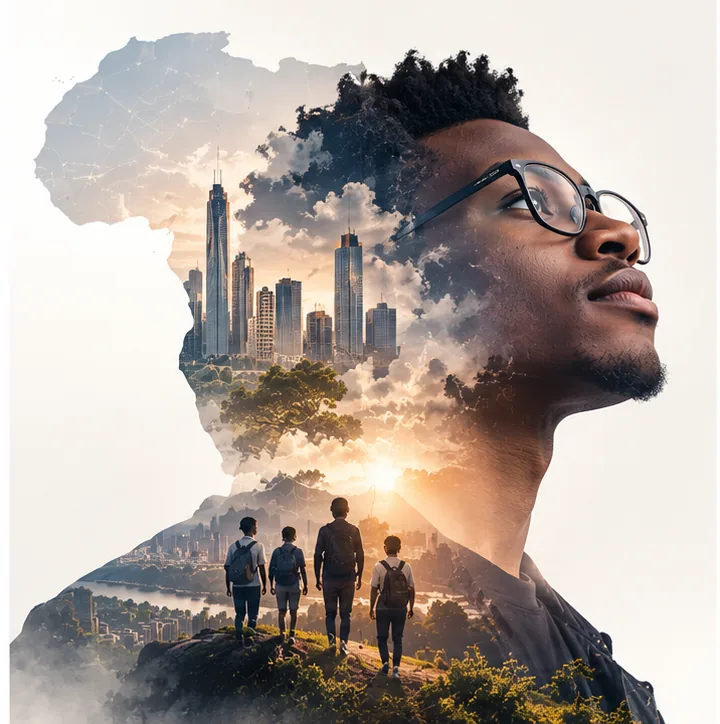 Flagship
Project 100,000 — Africa's Purpose Generation
Insights
Evidence before attribution.
Our research, frameworks and field reflections—published with clear labels for what is verified, proposed or still being tested.
 Journal
Ideas for intentional futures
Get involved
There is a place for your contribution.
Students, graduates, teachers, schools, companies, funders and researchers—find the pathway that fits what you can bring.
 Fellowship & volunteers
Your location could become your assignment

An African-led social enterprise
We research how people and cultures are formed—and build the systems, experiences and movements that help Africa's next generation live, lead and build on purpose.
In Africa. For Africa. By Africans.
01 Our conviction
Africa's future will be shaped by what its young people come to believe is possible—and by the schools, communities and institutions around them. We think that is too important to leave to chance.
We work in Africa, for Africa, by Africans: drawing on global research, international expertise and partnership, while keeping local insight, agency, dignity and ownership at the centre.
Vision
An Africa in which people understand their purpose, develop the capacity to fulfil it, build healthy communities and create institutions that serve present and future generations.
Mission
To research and engineer positive cultural change; develop complete, responsible and capable people; mobilise community-led projects; and equip organisations to create, manage and demonstrate meaningful social value.
Our organising promise
We turn insight into capability, capability into purposeful action, and purposeful action into enduring social value.
Read our story and convictions02 Our defining discipline
“The systematic study, intentional design, testing and stewardship of the beliefs, behaviours, relationships, norms and institutional arrangements that influence collective outcomes.”
Culture is not a fixed identity. It is the learned pattern of belief, behaviour, relationships, norms and institutions that shapes what a society considers possible. Culture Engineering studies those patterns—and helps communities change the conditions around them, not only the conversation.
03 The challenge before us
A demographic opportunity will not automatically become a development dividend. It depends on whether young people can build capability, agency and real experience—and on whether the institutions around them help.
Ledger A
Young Africans are not a problem to be solved. They are the people who will design what comes next.
Africa · 2026 estimate
19years
Approximate median age in Africa today, projected to rise to 35 by 2100.
UN World Population Prospects 2024, via Pew Research Center (May 2026)
Africa · projection
1 billion+
UNICEF projects Africa's under-18 population will top one billion by 2055.
World's under-25s living in Africa
More than a quarter of the world's young people live in Africa today; by 2100, close to half are projected to (under-25s, not only children).
UN WPP 2024, via Pew Research Center (May 2026) · 2100 is a projection
Ledger B
Learning, belonging and real opportunity are not yet reaching enough young people.
Sub-Saharan Africa · 2024 brief
Nearly 9 in 10
children in sub-Saharan Africa struggle to read by age 10.
World Bank — Education in Eastern & Southern Africa (Oct 2024)
Africa · 2025 scorecard
118 million
children, adolescents and youth of primary to upper-secondary age are out of school across Africa.
UNESCO Institute for Statistics — 2025 Africa SDG 4 Scorecard
Africa · each year
young Africans enter the labour force each year, while about 3 million formal jobs are created.
Sub-Saharan Africa · ages 15–24
21.9%
of young people were not in employment, education or training in 2023. The ILO projects 21.8% for 2024.
ILO — Global Employment Trends for Youth 2024: Sub-Saharan Africa
Beneath the numbers
Too often, effort treats the visible symptom and leaves the conditions that reproduce it untouched.
Risks we design against—not claims about any particular organisation.
Our response
Connect personal development, cultural systems, applied learning and organisational social value in one measurable, locally owned model.
Figures refer to the geography and year stated by each source: “Africa” and “sub-Saharan Africa” are not interchangeable, and projections are not observed outcomes. Every figure has been checked against its original source. Verified against source
04 How we work
We are not interested in interventions that disappear when an event ends. Every programme moves through six stages—and every stage is measured, so we learn and adapt as we go.
Stage 01 / 06
Listen first. Diagnose the behavioural and systemic patterns behind a challenge, with the people who live it.
Outputs
Evidence we look for
Stage 02 / 06
Co-design context-appropriate interventions with communities, schools and partners—never an imported template.
Outputs
Evidence we look for
Stage 03 / 06
Pilot with partners and validate through evidence before anything grows.
Outputs
Evidence we look for
Stage 04 / 06
Build local ownership: recruit and train field associates, teacher patrons and volunteers who carry the work.
Outputs
Evidence we look for
Stage 05 / 06
Help schools, organisations and communities sustain what works after the first cycle ends.
Outputs
Evidence we look for
Stage 06 / 06
Replicate only validated models, through accountable partners, with safeguards in place first.
Outputs
Evidence we look for
Measure, learn and adapt at every stage. Every transition requires evidence, feedback and adaptation.
How the method works in practice05 What we do
Our work connects research with practical interventions, education with application, and individual transformation with community and societal development. Each engine strengthens the others.
Understanding how beliefs, behaviours and institutions form—and how they can be ethically reshaped.
Research, diagnostics, applied models, learning pathways and institutional culture-change projects. A developing interdisciplinary framework—not a claim that culture can be controlled.
Homo Completum: purpose, character, capability and wellbeing developed together.
The OnPurpose Academy, purpose formation, leadership and field-based learning—education that forms judgment and action, not only knowledge.
From individual purpose to local platforms for collective action.
Purpose Clubs, the OnPurpose Tour, Project 100,000 and locally led initiatives—designed for local stewardship and safe school supervision.
Helping organisations design community benefit that can be delivered and evidenced.
Strategy, programme design, implementation, monitoring and reporting for corporations, foundations, public institutions and civil society.
Generating knowledge, testing models and building replicable systems for change.
Futures Labs, the Africa Culture Engineering Summit (ACES), fellow and volunteer networks, collaborations and knowledge-sharing.
06 Our initiatives
Each initiative connects learning to a school, a community or an institution—and to evidence of what changed. Programme names describe our planned delivery architecture, not completed reach.
Flagship initiative
A continent-wide movement to help young Africans discover purpose, develop character, exercise leadership and transform their communities—through books, Purpose Clubs, mentorship and service.
copies of Why On Earth Am I On Earth? placed in structured learning journeys—the founding 12-month cycle, beginning in Nigeria.
distinct under-18s across Africa meaningfully reached within a decade. An ambition, not a result.
07 The complete person
Our educational philosophy resists reducing a human being to examination results, technical skill, income or status. It asks whether education is forming a person who can live responsibly, relate well and contribute meaningfully.
Inclusive by design: values-informed and respectful of religious and non-religious participants. An educational lens—not a diagnostic, medical or spiritual test.
09 Fellowship & volunteer movement
Your location could become your assignment.
Culture Engineering students, field associates, youth corps members, teachers and volunteers form the local, accountable network that carries the work into schools and communities—trained, supervised and safeguarded.
Open for expressions of interest
Begin with CE 101: culture dynamics, purpose, ethics and observation.
Support Purpose Clubs, school relationships and supervised field projects.
Build a verified portfolio of evidence, reflection and supervisor review.
Advance from Student to Associate, Culture Engineer and beyond—on evidence, not attendance.
What you do becomes what you can prove.
10 Our impact ambition
A mission statement is not evidence of delivery. We report what is verified separately from what we are aiming for—and we will publish disappointing findings as well as positive ones.
Verified to date
No outcome data published yet.
Our programmes are in development. Verified results will appear here only after measurement against a baseline and review—reach reported separately from outcomes.
What we are working toward
100,000
books placed in structured learning journeys in the founding 12-month cycle in Nigeria.
100M
distinct under-18s across Africa meaningfully reached within ten years.
Depth before reach. Illustrative priorities—not claims of completed milestones or guaranteed dates.
Reach is necessary, but it is not the same as impact. No fabricated baselines. No outputs presented as outcomes. No unverified attribution.
11 Build the future with us
If you believe Africa's future can be intentionally shaped through better people, stronger cultures and more responsible institutions, start here.
Not sure where you fit? The OnPurpose Guide can explain our work and point you to the right pathway.
Or use the pathway finder
08 For organisations
From good intentions to measurable benefit.
Our Social Value Studio helps corporations, foundations, governments and civil society move beyond isolated CSR activity to well-designed, accountable programmes that communities help shape.
What a commissioning partner receives
“A commissioning partner should receive more than a glossy impact story.”
We do not promise a social return ratio or claim community outcomes without a defensible method and data.